What defines a bodybuilder? Is it the amount they can lift? Or is it how good they look in posing clothing?
For most people, when this term is heard, images of hugely muscled, oiled up men in bikini bottoms register in their minds. Men, on stage under bright lights, flexing their gargantuanbiceps until they threaten to pop out of their arms. Giants like Arnold Schwarzenegger andLee Haney.
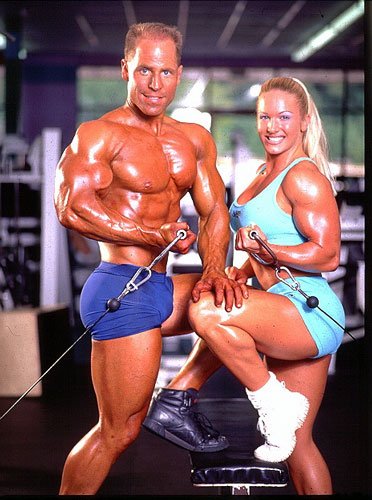
Men whose single, overwhelming goal in life is to grow bigger muscles, until they fill an entire room. And women too. Women, far more muscular than the average professional football player, flexing and straining under those same bright lights while crowds cheer them on.
These men and women are bodybuilders. It's obvious, of course, very hard to miss.
Who Else Is A Bodybuilder?
A baseball player hits the weight room hard in the off-season to improve his power at the plate. Is he a bodybuilder?
A sprinter performs 100-meter runs while attached to a parachute harness to improve his acceleration during competitions. Is he a bodybuilder?
A tennis player performs polymeric drills, hopping from side to side over cones and leaping onto and off box platforms. She does this in order to improve her quickness and agility on the court. Is she a bodybuilder?
A retired college professor, dismayed at the way his waistline has been steadily growing over the last few years, begins a morning jogging routine and changes his diet to get rid of those extra pounds. Is he a bodybuilder?
The answer to every one of these questions is yes. They are all bodybuilders. While their methods are as varied as the goals they wish to achieve, these people all have one thing in common. They are all making a conscious effort to improve their bodies. And that is what a bodybuilder does.
There is no minimum number of hours that have to be spent in the gym to become a bodybuilder. There are no required exercises, or number of sets or repetitions that have to be completed before one is considered a bodybuilder. A bodybuilder doesn't have to be under ten percent body fat.
In fact, a bodybuilder doesn't even have to lift weights. Most do, though, because - let's face it - lifting weights works.
What Makes A Body Better?
What changes have to be made to your body for it to be improved upon?
If you ask that question to ten different people, odds are you'll receive ten different answers. And as long as those people truly believe their answers, they are all correct. What makes a body better is defined by the sole discretion of its owner.
To the physique competitors posing and flexing under those bright lights, a better body means a body like an anatomy chart with muscles that are as large, symmetrical, and defined as humanly possible. That perception of a better body is a far cry from that of the tennis players, who most likely considers a better body to be one that is lean, fast and agile.
A body that helps her win set after set. It's an even further cry from that of the retired college professor, who's idea of a better body may simply be one that looks more like it did ten or twenty years ago.
So next time you hear the term "bodybuilder", hopefully you won't limit your thoughts to bottles of baby oil and posing briefs. The concept of the bodybuilder is much deeper and far-reaching than that. And if you look closely, you'll see that bodybuilders are everywhere.
1 /you can get as big as a pro bodybuilder without taking steroids; it just takes longer
Despite what many of the magazines say, all professional bodybuilders use either steroids or steroids in combination with other growth-enhancing drugs. Without manipulating hormones, it just isn't possible to get that degree of muscularity, the paper-thin skin, and the continuing ability to pack on mass, despite sometimes having poor workout habits and relative ignorance of the principles involved that many pro bodybuilders have. Many supplement distributors, in order to sell their products, would have you believe otherwise.
Still, that's no reason to give up. By using state-of-the-art training principles, consuming a nutrient-rich diet, and by getting proper amounts of rest, almost every person can make incredible changes in his or her physique. The competitive bodybuilder circuit may not be in your future, but building the kind of physique that gains you respect is certainly achievable, as are self-respect and robust health.
2 /In order to get really big, you have to eat a super-high-calorie diet
Well, that's true; you'll get really big if you eat a super high-calorie diet, but you'll look like theMichelin Man's fraternal twin. However, if you want to get big, lean-tissue wise, then super-high-calorie diets are probably not for you unless you are one of those very few people with metabolic rates so fast you can burn off these calories instead of depositing them as fat. Unfortunately, studies show that, in most people, about 65% of the new tissue gains brought about by high-calorie diets consists of fat!
Of the remaining 35%, approximately 15% consists of increased intracellular fluid volume, leaving a very modest percentage attributable to increased lean muscle mass.
According to Dr Scott Connelly (MM2K, Spring 1992, p. 21), only about 20% to 25% of increased muscle growth stems from increased protein synthesis. The rest of the muscle growth is directly attributable to increased proliferation of the satellite cells in the basal lamina of muscle tissue, and dietary energy (calories) is not a key factor in the differentiation of these cells into new myofibres (muscle cells).
Of all factors determining muscle growth, prevention of protein breakdown (anti-catabolism) seems to be the most relevant, but adding adipose [fat] tissue through constant overfeeding can actually increase muscle pro-teolysis (breakdown). Furthermore, additional adipose mass can radically alter hormone balances which are responsible for controlling protein breakdown in muscle. Insulin balance, for one, which partially controls anti-catabolism in the body, is impaired by consistent overfeeding. So much for the eat-big-to-get-big philosophy!
Stay away from the super-high calorie diets unless you're a genetic freak, or you're woefully lean and don't mind putting on fat [or you're using appropriate pharmaceutical supplements].
3 /If you eat a low-fat diet, it doesn't matter how many calories you take in, you won't gain any fat
The bottom line is, if you exceed your energy requirements, you'll gradually get fatter and fatter. It's true that eating a diet rich in fat will pack on the pounds quicker for a variety of reasons, the most significant being that a gram of fat has nine calories as opposed to the four calories per gram that carbohydrates and proteins carry.
Fat is also metabolized differently in the body. It takes a lesser amount of calories to assimilate the energy in ingested fat than it does to assimilate an equal (weight wise) amount of carbohydrates. Consequently, more fat calories get stored than carbohydrate calories. However, the gross intake of carbohydrates, as facilitated by many of the weight-gain powders, will make you fat very quickly.
4 /The more you work out, the more you'll grow
No, no no. This is one of the most damaging myths that ever reared its ugly head. 95% of the pros will tell you that the biggest bodybuilding mistake they ever made was to over-train--and this happened even when they were taking steroids. Imagine how easy it is for the natural athlete to overtrain! When you train your muscles too often for them to heal, the end-result is zero growth and perhaps even losses. Working out every day, if you're truly using the proper amount of intensity, will lead to gross overtraining. A body part, worked properly, i.e. worked to complete, total muscular failure that recruited as many muscle fibers as physiologically possible, can take 5-10 days to heal.
To take it a step further, even working a different body part in the next few days might constitute overtraining. If you truly work your quads to absolute fiber-tearing failure, doing another power workout the next day that entails heavy bench-presses or deadlifts is going to, in all probability, inhibit gains. After a serious leg workout, your whole system mobilizes to heal and recover from the blow you've dealt it. How, then, can the body be expected to heal from an equally brutal workout the next day? It can't, at least not without using some drugs to help deal with the catabolic processes going on in your body [and even they're usually not enough .]
Learn to accept rest as a valuable part of your workout. You should probably spend as many days out of the gym as you do in it.
5 /The longer you work out, the better
It just isn't necessary to do 20-30 sets for a body part, or even 10 sets like many 'experts' would have you believe. In fact, research has shown that it's possible to completely fatigue a muscle in one set, provided that that set taxes a muscle completely, i.e. incorporates as many muscle fibers as possible and takes them to the point of ischemic rigour where, rather than contract and relax, the muscle fibers freeze up, sort of like a microscopic version of rigor mortis. Any further contraction causes microscopic tearing. Hypertrophy is just one adaption to this kind of stress and it's naturally the kind most bodybuilders are interested in.
This kind of intensity can usually be achieved by doing drop or break-down sets where you rep out, lower the weight, and continue doing reps until you either can't do another rep or you've run out of weight. It can also be achieved by doing your maximum number of reps on a particular exercise: by a combination of will, tenacity, and short rest periods, you complete ten more reps. You achieve the short rest periods by locking out the weight-bearing joint in question without putting the weight down. In other words, completely surpass your normal pain and energy thresholds.
If you can truly work your muscle to the point described, it will afford you little, if any, benefit to do another set (Westcott, 1986). The exception would be the body parts that are so big that they have distinct geographical areas, like the back, which obviously has an upper, middle and lower part. The chest might also fall into this category, as it has a distinct upper and lower part, each with different insertion points.
6 /You don't have to be strong to be big
For a variety of reasons, people, even those with an equal amount of muscle mass, vary in strength enormously. It might have something to do with fast-twitch/slow-twitch muscle ratios, or it might have something to do with the efficiency of nerve pathways or even limb length and the resultant torque.
But it is still a relative term. To get bigger muscles, you have to lift heavier weight, and you, not the guy next door, have to become stronger -- stronger than you were. Increasing muscle strength in the natural athlete, except in a very few, rare instances, requires that the tension applied to muscle fibres be high. If the tensions applied to muscle fibers are light, maximal growth will not occur (Lieber, 1992).
7 /the training programs that work best for pro bodybuilders are best for everyone
You see it happen every day in gyms across the country. Some bodybuilding neophyte will walk up to a guy who looks like he's an escaped attraction from Jurassic Park and ask him how he trains. The biggest guy in the gym likely got that way from either taking a tremendous amount of drugs and/or by being genetically pre-dispositioned to get big. Follow a horse home and you'll find horse parents.
The guy in your gym who is best bodybuilder is the guy who has made the most progress and done the most to his physique using natural techniques. He may still be a pencil neck, but he may have put on 40 pounds [19kg] of lean body mass to get where he is, and that, in all probability, took some know-how. That person probably doesn't overtrain, keeps his sets down to a minimum, and uses great form and concentration on the eccentric (negative) portion of each exercise repetition.
Many pros spend hours and hours doing innumerable sets--so many it would far surpass the average person's recuperative abilities. If average people followed the routines of average pro bodybuilders, they would, in effect, start to whittle down what muscle mass they did have or, at best, make only a tiny bit of progress after a couple of years.
8 /You can't build muscle on a sub-maintenance calorie intake diet
It may be a little harder, and it may require a little bit more know-how and a little bit more conscientious effort, but it can be done. The fact is, the obese state in humans and animals is not universally correlated with absolute levels of caloric intake and neither is the accrual of lean body mass. The ability to realize changes in lean/fat ratios is regulated by components of the automatic nervous system working in concert with several endocrine hormones; this is called nutrient partitioning.
For example, certain beta-agonist drugs like Clenbuterol increase meat production in cattle over 30% while simultaneously diminishing bodyfat without increasing the amount or composition of their feed. Other drugs, including growth hormone, certain oestrogens, cortisol, ephedrine, and IGF-1 are all examples of re-partitioning agents. All increase oxygen consumption at the expense of fat storage--independent of energy intake.
Drugs are not the only way to do this, however. It's true that a significant component of this mechanism is genetically linked, but specific nutrients, in specific amounts, when combined with an effective training programme, can markedly improve the lean/fat ratio of adult humans.MET-Rx is one such nutrient re-partitioning agent, and several companies are trying to duplicate its successes.
9 /You can't grow if you only work each body part once a week
If you work out -- work out intensely-- then it can take 5-10 days for the muscles to heal. Although the following should be taken with a grain of salt when determining your own exercise frequency, a study in the May 1993 issue of the Journal of Physiology revealed it can take weeks for muscles to recuperate from an intense workout. The study involved a group of men and women who had worked their forearms to the max. All of the subjects said they were sore two days after exercising, and the soreness was gone by the seventh day, and the swelling was gone by the ninth day.
After six weeks, the subjects had only gained back half the strength they had before the original exercise!
By no means are we advocating that you wait two months between workouts, but we are trying to prove the point that it takes muscles longer to heal than what you might have previously thought. For some people, especially natural bodybuilders, waiting a week between body part workouts might be just what the doctor ordered for size and strength gains!
10 /You can't make gains if you only train with weights three days a week
Although you probably couldn't find a single steroid-assisted athlete who trains only three days a week, there's absolutely no reason why a three-day-a-week routine couldn't work for many natural athletes. As long as your routine attacked the whole body and you worked to failure on each set, you could easily experience great gains on this sort of routine.
However, you need to pay even more attention to your diet if you only train three days a week, especially if your job involves little or no physical activity, and you like to spend your idle time eating. Ignore those who say three-day-a-week bodybuilders are only 'recreational lifters'. Think quality and not quantity.
Breakfast (8.00am):
Ø One six egg omelette with cheese.
Ø One glass of milk.
Ø One cup of oatmeal.
Mid-Morning Snack (10.30am):
Ø One whey protein shake.
Ø Two bananas.
Ø Small bowl of rice.
Ø One slice of cheese (50 grams).
Lunch (12.30):
Ø One chicken breast.
Ø Large bowl of rice.
Ø One glass of milk.
Mid-Afternoon (3.00pm):
Ø One whey protein shake.
Ø One apple.
Ø One carrot.
Ø Two peanut butter sandwiches.
Dinner (6.00pm):
Ø 350 grams of steak.
Ø One glass of milk.
Ø Two large potatoes.
Ø 200 grams of broccoli.
Evening Meal (9.00pm):
Ø One whey protein shake.
Ø Small bowl of rice.
Before bed (10.30; optional):
Ø One whey protein shake.

No comments:
Post a Comment